A story of the legendary 25W “Otala” amplifier as seen by Terje Sandstrøm, one
of the original designers.
Also see “The People Involved”, for other designers and
people who contributed.
Introduction — the birth of the Otala amplifier
At an AES conference in 1973, Dr. Matti Otala presented a paper describing the design of a TIM-free audio amplifier. Among those attending was Svein Erik Børja, a Norwegian record and broadcasting producer and dedicated audio enthusiast. Børja was widely recognised for his exceptional listening ability—what audiophiles of the day referred to as a “Golden Ear.” Dissatisfied with the sound quality of many transistor amplifiers of the time, he immediately recognised the significance of Otala’s work. The theory behind TIM also provided an explanation for imperfections that he himself had consistently identified by listening.
Looking back, this became one of the foundations of our design philosophy: careful listening, objective measurements, and theoretical analysis. All three had to point in the same direction before we considered a design change to be successful.
Børja brought the paper to Nils Jørgen Kjærnet at Nera in Oslo. Together they built two prototype amplifiers based on the Otala/Lohstroh schematics. Kjærnet designed the printed circuit boards and, to the best of my knowledge, also contributed to the mechanical design.
The promising results led Børja to contact his friend Per Abrahamsen, who was then running Electrocompaniet. Per decided to build a couple of amplifiers to evaluate the design. They fulfilled all expectations and sounded so good that Electrocompaniet decided to manufacture a production series, marking the company’s transition from professional audio equipment to high-end audio.
I started hanging around Electrocompaniet in the autumn of 1974 and began working for Per in the spring of 1975. One of my first tasks was assembling the first production series of the Otala amplifiers—a run of ten units built on the same printed circuit boards as the original two prototypes.
During the summer I started looking at the design. Having designed and built electronic equipment as a hobby since my early teens, I naturally wanted to understand how it worked. At that time neither Per nor I had much experience in high-end audio design. In retrospect, that may well have contributed to the amplifier’s success. We didn’t know how it was supposed to be done, so we worked it out ourselves within the framework provided by Otala’s design.
In many ways we belonged to the first generation of amplifier designers to develop products with TIM as a primary design criterion. We were learning as we went, building on the foundation laid by Otala’s work.
The first Otala amplifier in “production”
The first amplifier series used the same printed circuit boards as the first
two prototypes. The PCB was a two-layer design — we called it a T-board, due to
its shape. The power transistors were mounted onto the cooling fin from both
sides of the stem of the “T”. One layer of the board was a ground plane (Nera
being an RF company, that wasn’t so strange). The ground plane caused us a lot
of mounting problems, because the component legs often got stripped when they
were squeezed through the holes in the PCB, causing small metal pieces from the
legs to curl up and make sweet, nearly invisible, shorts to the ground plane.
We did see smoke …
In the autumn of ‘75 we started to get some attention, and a visit to Matti
Otala at the VTT (Valtion Teknillinen Tutkimuskeskus — the Technical Research
Centre of Finland), where he worked as a professor, became necessary. There
were several reasons:
We had named the amplifier “Otala-Lohstroh” after its inventors, and Otala
wanted to see the amplifier before he and Lohstroh could possibly allow us to
use his name.
At the same time, we started to experience problems with the amplifier — it
didn’t quite meet the specifications stated in the AES paper. We needed his
help.
As it turned out, the amplifier was renamed to “The 2-channel audio power
amplifier”, which was the name used for the rest of the amplifier’s lifetime.
The relationship with Otala was established, and he visited the company on
several occasions. There is still good contact between Otala and
Electrocompaniet.
Period of confusion, start of revision
It was early 1976. We started to invest in measuring equipment. The company
slowly turned into an audio amplifier company. It lost several of its old
customers; the loudspeakers it sold became more neglected. We worked from
early morning into the late nights. That would be the standard for the next
4 years. An amplifier brought to the US by Svein Erik blew
up at the first listening test — embarrassing. We used the night to invent a
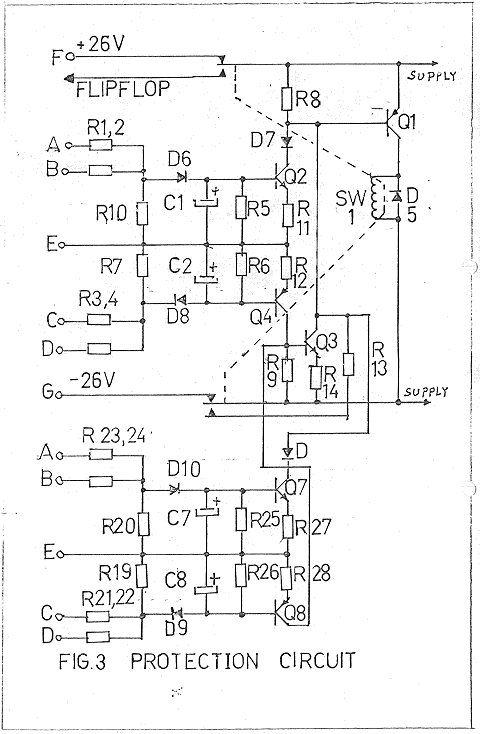
new type of short-circuit protection. We didn’t want
anything that could affect the sound, so we simply used a high-impedance
circuit to sense the current through the output transistors, and then used a
relay to switch off the voltage to the output transistors. It worked!
We now understood that we had to start changing the amplifier. Svein Erik’s
golden ears became even more important than ever before. We were in uncharted
territory; the old measurement methods could not be trusted. We had to rely on
our own methods, our own interpretations of the measurement results. Now began
an active period of theory, practice, and reading articles (Svein Erik provided
us with articles en masse, on all aspects of audio design and electronics
design in general).
We found that the compensation scheme used in the amplifier did not work
correctly. As we measured the bandwidth to be far less than specified, we
needed to redesign these filters. The amplifier used shunt feedback — one of
its really strong points — with an input lag compensation; at each of the
three amplifying stages, a lead-lag compensation was introduced. These did not
match the actual poles we measured. One of the reasons for this, we assumed,
was that the original design used “fresh,” newly developed Philips
transistors. As both Otala and Lohstroh were working at the Philips labs in
Eindhoven at the time of the design, we assumed they had access to better
transistors. (I don’t remember if Otala ever confirmed this to be the case.)
In any case, a period followed where we changed the compensation back and
forth with little or no effect. We did achieve something, but no significant
improvement.
We had also now measured the distortion (having just bought our first
distortion measurement set and spectrum analyzer). It wasn’t pretty — the
distortion was far worse than specified, and performance was far below even
our own expectations. Again we didn’t manage to do anything significant at
first.
A major change came first when we started to change the quiescent current of
the transistors. The design was in fact done as a mix between the old way and
the new way. Older design books teach that you should use low current in the
first stage due to noise. This was also done here (see “Noise Optimisation”
for an explanation of why that’s not actually the case). We knew this theory
was wrong, so we increased the quiescent currents, which decreased the
resistance and again dramatically increased the bandwidth of the amplifier.
The distortion also went down — not dramatically, but enough to make a
significant change for the better in the sound (see “Transistors, Resistors,
Current and Distortion” — not yet written).
The Audio Critic
At this time we started to hear rumours about a
test in
the US on our amplifier. One day our mail started to overflow, and a few days
later we got hold of the test ourselves. It was in a magazine named The Audio
Critic, and the test was fabulous. It started:
Audio freaks - Eat your hearts out: This is the worlds best sounding
amplifier, and One: You can’t buy one in this country (The USA!), and Two:
(not surprisingly - the only slightly negative in the whole test) It is too
low powered to be counted.
Suddenly we had more requests for amplifiers than we could hope to handle.
Sales boomed. It was mid-‘76.
We worked throughout the summer, from morning until late at night, seven days a week. It was an intense period, driven by enthusiasm and the determination to make the amplifier a reality.
The great change
Dr. Otala’s work on TIM was often interpreted as an attack on high-feedback amplifiers. While it is true that high-feedback designs can be more prone to TIM than low-feedback designs, there is nothing inherently magical about low feedback.
The primary goal of any amplifier is to reproduce the input signal as accurately as possible, neither adding nor subtracting anything. TIM is simply one form of distortion; reducing one type of distortion at the expense of increasing another is not, in itself, an improvement.
It is true that some types of distortion are more objectionable to the ear than others, so there is always a balance to be struck. If, for example, 0.1% TIM is considered subjectively equivalent to 1% THD, then an amplifier with 2% THD and 0.07% TIM is likely to sound worse than one with 1% THD and 0.1% TIM.
We gradually came to realise that achieving the right balance between different forms of distortion was the key. It was not simply a matter of balancing THD against TIM, but also low-frequency distortion against high-frequency distortion, frequency and phase response against nonlinear distortion in general, and so on.
This insight led to The Great Change.
One night (it always seemed to happen at night!) we increased the feedback by 10 dB, bringing the total feedback to 30 dB. The improvement in sound quality was remarkable—and completely contrary to the prevailing beliefs within our own community.
From that point on, only minor adjustments were made to the amplifier. It had essentially reached the form it would retain throughout the rest of its life at Electrocompaniet.
Although never a high-volume product, the amplifier earned an international reputation and became the foundation on which Electrocompaniet built its name.
On marketing
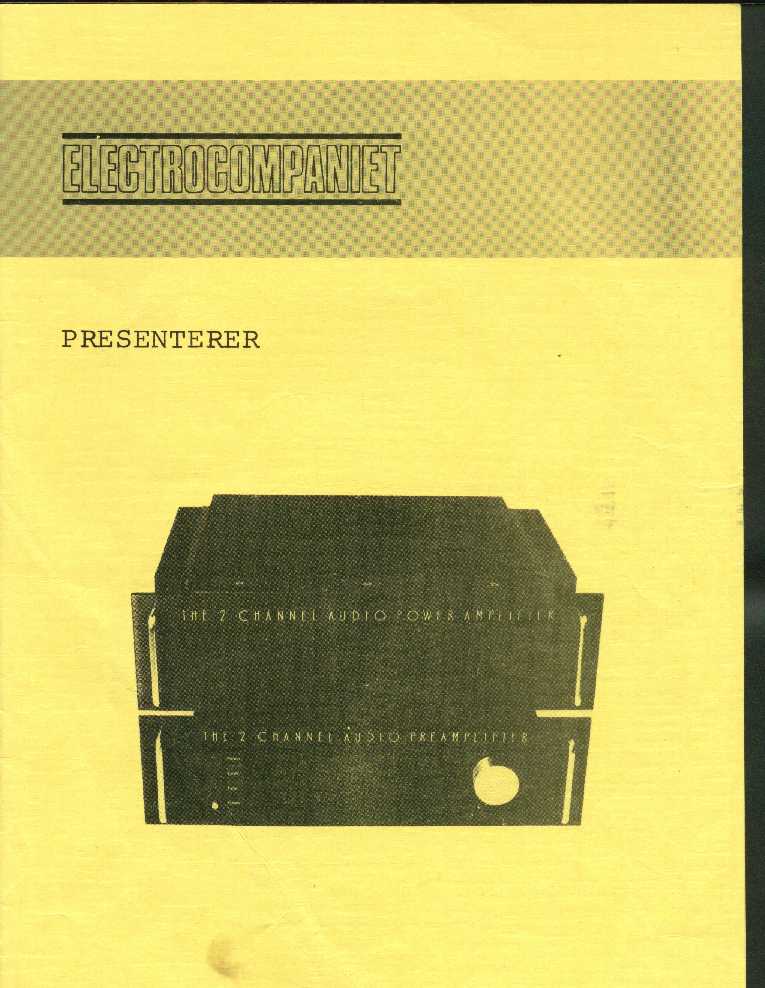
We did brochures! The first one was rather
technical. The second one was more
professional. The rest of the marketing was done by word-of-mouth. The fact
that the amplifier and the company were both hard to get hold of stimulated
the market. Here was a mysterious company with a killer amplifier. Audio
people love such stuff!
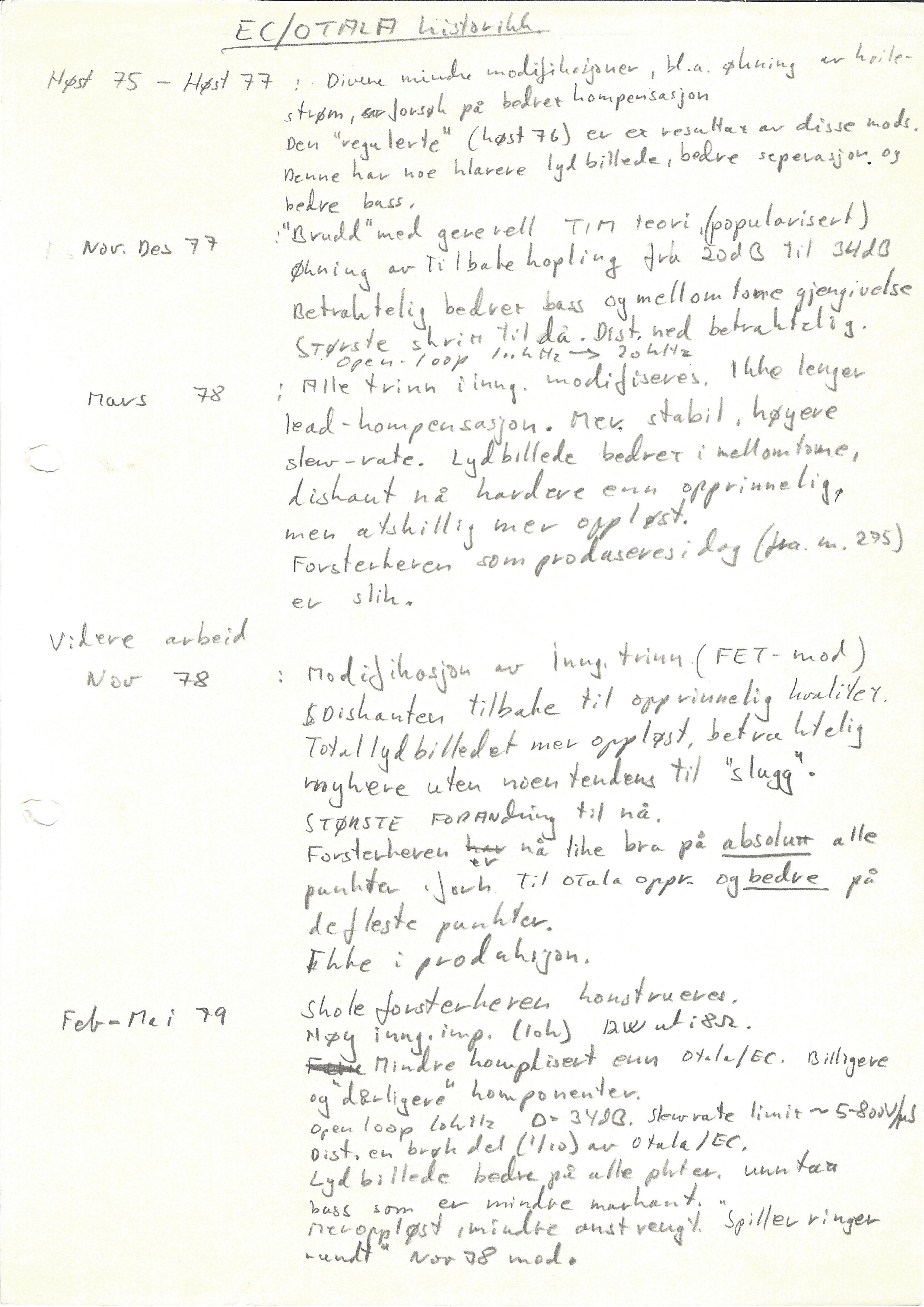
See the evolution notes, handwritten in Norwegian, but with English text extracted.
Subsections of The Story of the "Otala" Amplifier
The Evolution of the Otala/EC Amplifier — Handwritten Notes
EC/Otala historikk
I have found an older handwritten page about what was changed when, which can be useful to see the evolution of the amplifer, probably written around 1980. It is course, very honest some places, but we can live with that. And I see it is my own handwriting. The image of the note is in Norwegian, but the extracted text is in English.
English Translation
Autumn 75 – Autumn 77
Various minor modifications, among them increased idle
current, attempts at improved compensation.
The “regulated” version (Autumn 76) is a result of these mods.
This one has a somewhat clearer sound image, better separation and
better bass.
Nov. Dec. 77
“Break” with the general TIM theory (popularized).
Increase of feedback from 20 dB to 34 dB.
Considerably better bass and midrange reproduction.
Biggest step so far. Distortion down considerably.
Open loop 100 kHz → 20 kHz.
March 78
All stages, incl. input, modified. No longer
lead compensation. More stable, higher
slew rate. Sound image better in the midrange.
Treble now harder than originally,
but considerably more resolved.
The amplifier being produced today (from no. 295)
is like this.
Further Work
Nov. 78
Modification of input stage (FET mod).
Treble back to original quality.
Overall sound image more resolved, considerably
softer without any tendency toward “slagging.”
Biggest change so far.
The amplifier is now just as good in absolutely every
respect, compared with the original Otala version, and better in
most respects.
Not in production.
Feb.–May 79
The school amplifier designed.
High input impedance (10 kΩ), 12 W output into 8 Ω.
Less complicated than Otala/EC. Cheaper
and poorer components.
Open-loop bandwidth 20 kHz, feedback 34 dB. Slew-rate limit ~5–800 V/µs.
Distortion a fraction (1/10) of Otala/EC.
Sound image better in every respect, except
bass which is less pronounced,
more resolved, less strained. Runs rings
around the Nov. 78 mod.
Norwegian Transcribing
Høst 75 – Høst 77
Diverse mindre modifikasjoner, bl.a. økning av hvile-
strøm, forsøk på bedret kompensasjon.
Den “regulerte” (høst 76) er et resultat av disse mods.
Denne har noe klarere lydbilde, bedre seperasjon og
bedre bass.
Nov. Des 77
“Brudd” med generell TIM teori (popularisert)
Økning av tilbakekopling fra 20 dB til 34 dB.
Betraktelig bedre bass og mellomtone gjengivelse.
Største skritt til da. Distortion ned betraktelig.
Open loop 100 kHz → 20 kHz.
Mars 78
Alle trinn inng. modifiseres. Ikke lenger
lead-kompensasjon. Mer stabil, høyere
slew-rate. Lydbildet bedre i mellomtone.
Diskant nå hardere enn opprinnelig,
men adskillig mer oppløst.
Forsterkeren som produseres i dag (fra nr. 295)
er slik.
Videre arbeid
Nov 78
Modifikasjon av inng. trinn (FET-mod).
Diskanten tilbake til opprinnelig kvalitet.
Total lydbildet mer oppløst, betraktelig
mykere uten noen tendens til «slagg».
Største forandring til nå.
Forsterkeren er nå like bra på absolutt alle
punkter, i forhold til Otala opprinnelig og bedre på
de fleste punkter.
Ikke i produksjon.
Feb–Mai 79
Skoleforsterkeren konstrueres.
Høy inng. imp. (10 kOhm) 12W ut i 8 Ω.
Mindre komplisert enn Otala/EC. Billigere
og dårligere komponenter.
Open loop båndbredde 20 kHz, feedback 34 dB. Slew-rate limit ~5–800 V/µs.
Distortion en brøkdel (1/10) av Otala/EC.
Lydbilde bedre på alle punkter, unntatt
bass som er mindre markant,
mer oppløst, mindre anstrengt. Spiller ringer
rundt nov 78 mod.
The People Involved
Several people were involved in the development of the 25W amplifier. This
chapter takes the history from the perspective of the people involved, in
chronological order.
A Finnish professor named Matti Otala
(also here). On sabbatical at Philips in Eindhoven,
together with Jan Lohstroh he designed a TIM-free amplifier. It was one
step in Otala’s quest against the new distortion called TIM, and later DIM.
Svein Erik Børja, a Norwegian broadcast and record producer, heard the
presentation given by Dr. Matti Otala at an AES conference in Copenhagen in
1973. Together with Nils Jørgen Kjærnet at Nera he built two (or five) units based on the Otala/Lohstroh schematics.
Per Abrahamsen was contacted by Svein Erik, who knew him from his Mojo
Blues days as a producer, and also knew that Per had an audio/electronics company. Per was
mostly working with PA equipment, but the arrival of the Otala amp turned his
company, Electrocompaniet, into an audio company.
At this time several others were involved with the company, but I don’t
remember all of them, mostly because they were before my time, and also
because they slowly disappeared as the company changed from a PA company to an
audio company. Among these were Petter Hjerpseth and Klaus Væthe Jr.
The latter later became a good friend of mine, and we tried to make an audio
company together in 1983, with the help of Paal Rasmussen, my former
partner at NRF — more on that later. Petter
disappeared during 1975; Klaus stuck with the company on and off until
sometime in 1977/78.
I (Terje Sandstrøm) first turned up in late 1974, and started to visit EC
on a monthly basis. After half a year of this, Per told me we were both better
off if I started to work for him, instead of just spending his time. In the
beginning I mostly did assembly work, but during 1975 I worked myself up the
ladder, and later I did more and more of the theoretical work on the
amplifier, calculations and so forth. I stayed until 1979, but did some part
time work and consulting for EC until 1982.
It is important to note that Svein Erik stayed with the company as its Golden
Ear for a very long time. In a way this was his hobby!
Peik Borud entered the company in 1976. He was an M.Sc. engineer in
electronics, and an audio freak. He stayed throughout 1978, and was, together
with Per and me, one of the basic designers of the 25W amplifier in this
period. Peik did a lot during his time at EC.
Paal Rasmussen entered the company in 1977 and stayed on and off for
slightly less than a year. He came from Seas AS, a loudspeaker company, and
before that he had worked in England with several of the famous designers
there. He and I were two of the three who started The Norwegian Radio
Manufacturing Company in 1979 — more on this later.
Kjell Winther was our record provider, and got amplifiers in return. He
was also a hi-fi nut, working in a record store, and provided us with the
latest and best-sounding records for our sound tests.
Nils Kvam was a record producer who also worked with listening tests and
also provided opportunities for the company sales-wise. He stayed way longer than me.
Øistein Klevhus helped me with the Engineering High School (I was rarely
present …), and I got him a part-time job at EC from early ‘78 (or late ‘77)
until spring ‘79. We did the School Amplifier together,
spring ‘79.
Two of the people in production who really stayed for a while were Knut Arne
Jacobsen and his then-girlfriend Aud. There were also a couple of girls
who came from Tandberg to work in production — (their names are not
remembered). These also stayed for quite a while.
There were also some sales and managing people (Helge …, Jan
Richter, among others) involved from period to period. I’m working on
re-remembering their names. Any help from others is appreciated.
Others who contributed included, for example, Svein Erik’s brother, Bjørn
Børja, from Seas AS, who designed a cute little moving-coil amplifier that EC
manufactured for some time.
During 1979 the company relocated, I gradually left, and new people joined. Unfortunately, I no longer remember all of their names.
The first era of the original Otala amplifier came to an end around 1979–1980, marking the beginning of a new chapter for Electrocompaniet. The company moved to Skårer, where it remained until its bankruptcy in 2004. It was then acquired by Westcontrol and relocated to Tau in Rogaland.
Per continued with Abrahamsen Audio, where he reintroduced the Two Channel Audio Amplifier. However, I am not familiar with the technical details of that version.
This text was originally written some time in the late 1990’s, and minor
updates around 2005 and 2026
Protection Networks
Protection networks, power supplies, and other stuff not so interesting, but
still needed.
You’ve read the section on how this came about? If not,
go back and do so! Otherwise, take a look
at the world’s first protection network that did not affect the sound AT ALL.
Yes — it is the first one!
The design is very simple: passive sensing of current, then triggering a relay
which removes the supply voltage from the output stage. As you probably know,
the EC design uses one power supply for the voltage-amplifying stages and one
for the power output, where all the large currents go. This separation made
this protection scheme work. If not, big bangs would be heard …
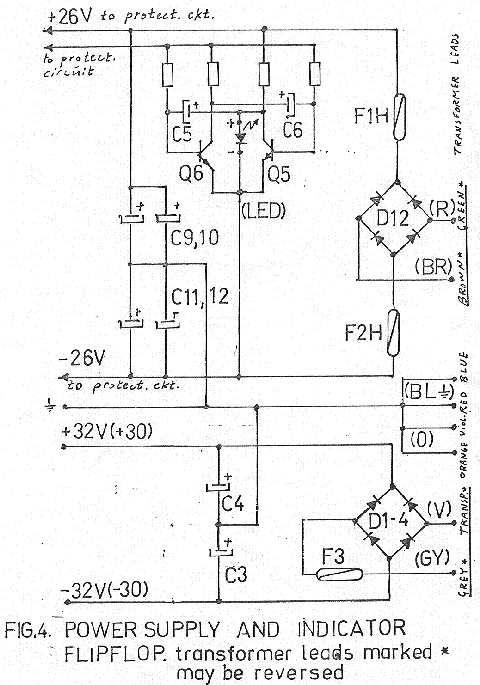
The power supply also needed some care.
However, we did not make it difficult. The major point here was the use of
small capacitors instead of the sluggish big ones everybody else used at that
time. We understood that small capacitors in parallel were a better choice
than single big ones.
The cabling was another issue — more on that later.
Marketing Brochures
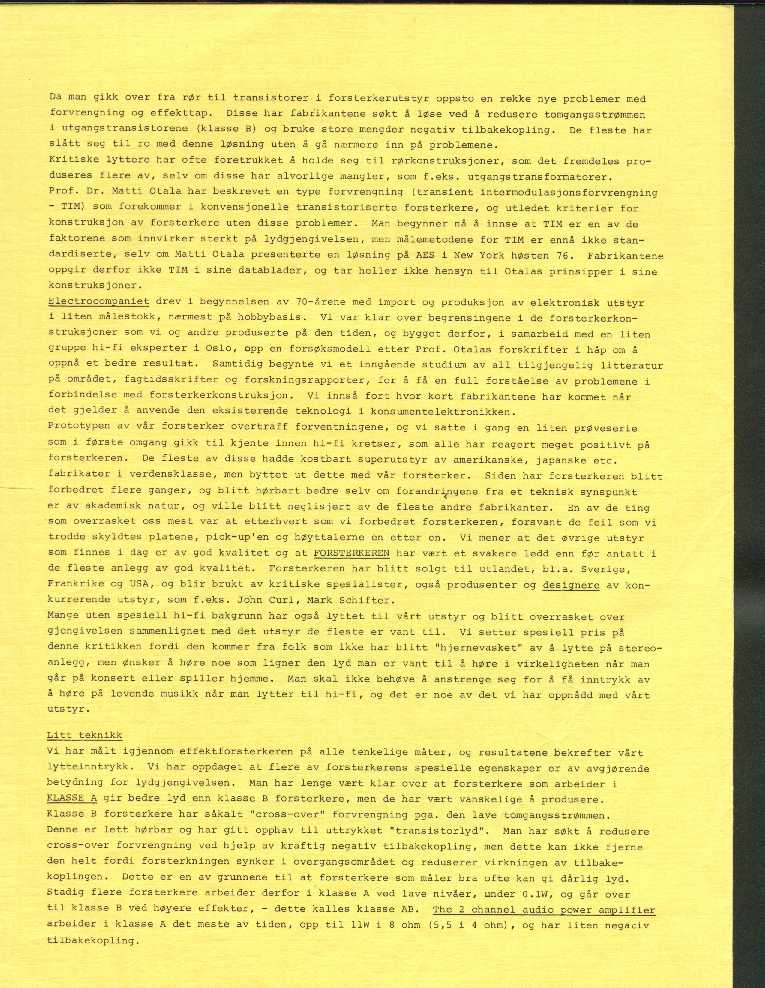
We did brochures! See the Otala story for the
context.
Our first brochure
It was rather technical.
The two remaining pages are still waiting to be scanned.
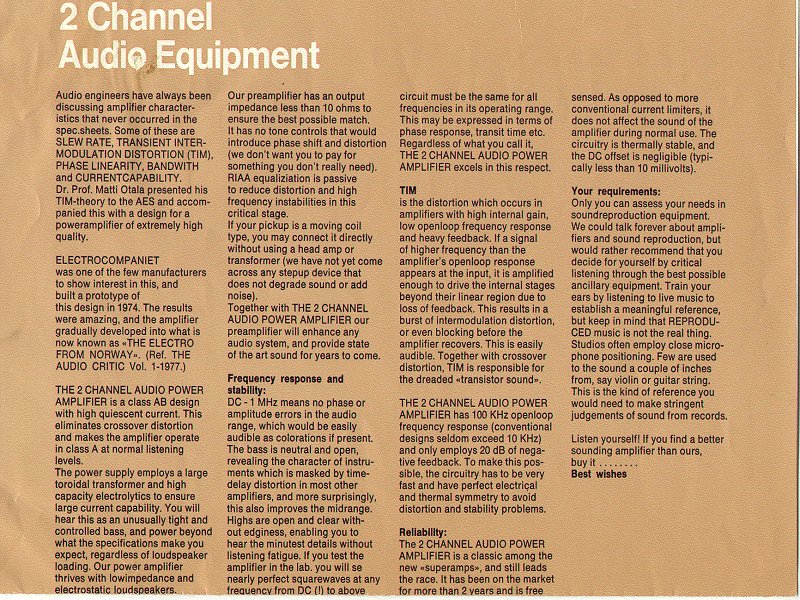
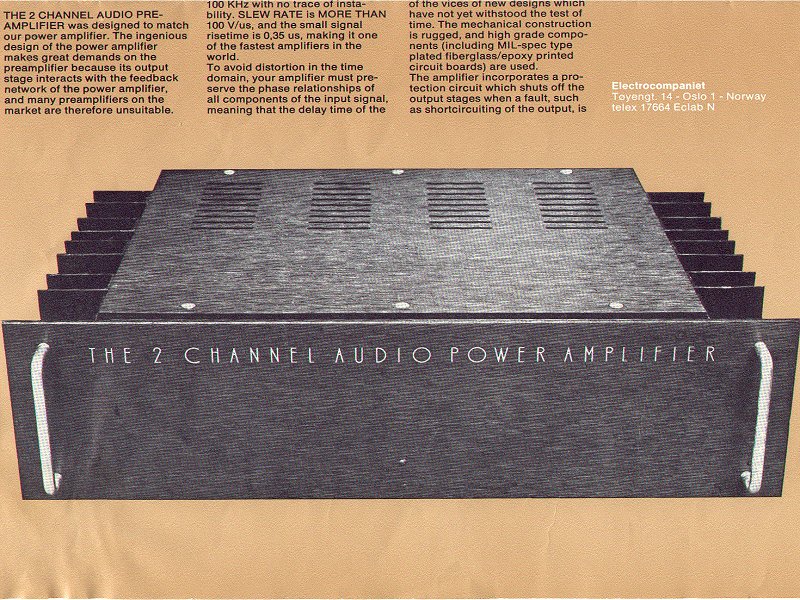
Our second brochure
More professional this time :-)
Norsk Radiofabrikk
Norsk Radiofabrikk — The Norwegian Radio Manufacturing Company
The company was founded in 1979 by Espen Evensberget, Paal Rasmussen, and myself. We aimed to develop and market our own designs, but most of our work involved modifying and refining the Two Channel Audio Amplifier.
The company also put out its own press release, “Tre Faser i en Utvikling”
(“Three Phases in a Development”), about the story of the Otala power
amplifier including the NRF modifications, written in 1979 — that document
hasn’t survived, or hasn’t been found again yet.